How Does a Miniature Gasoline Engine Work? Inside the F2 7.5cc Twin-Cylinder Engine

A miniature gasoline engine may fit in the palm of your hand, but the basic process happening inside it is remarkably similar to what happens inside a full-size four-stroke gasoline engine.
Fuel and air enter the cylinder. The piston compresses the mixture. A spark ignites it. Expanding combustion gases push the piston downward, and the crankshaft converts that movement into rotary mechanical power.
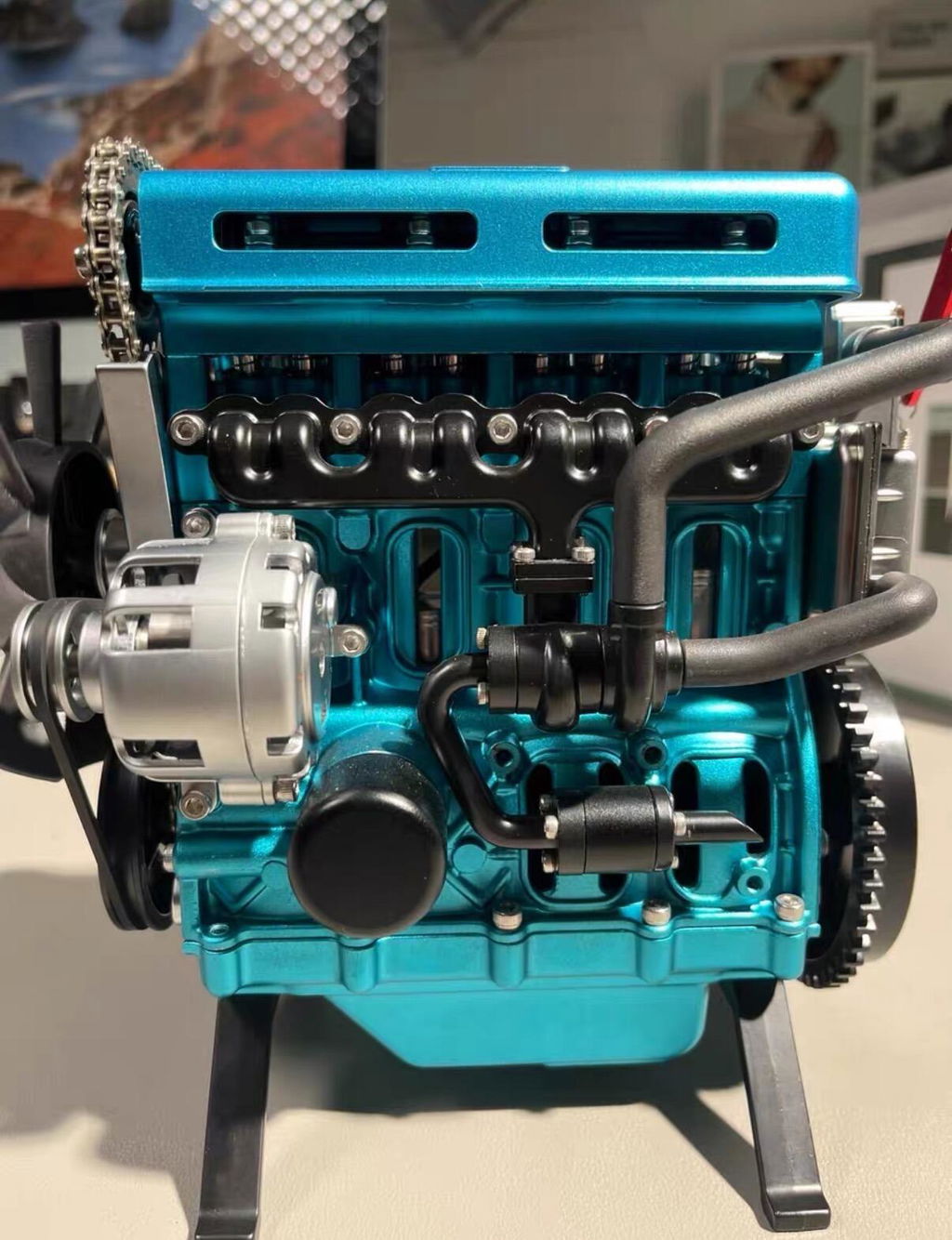
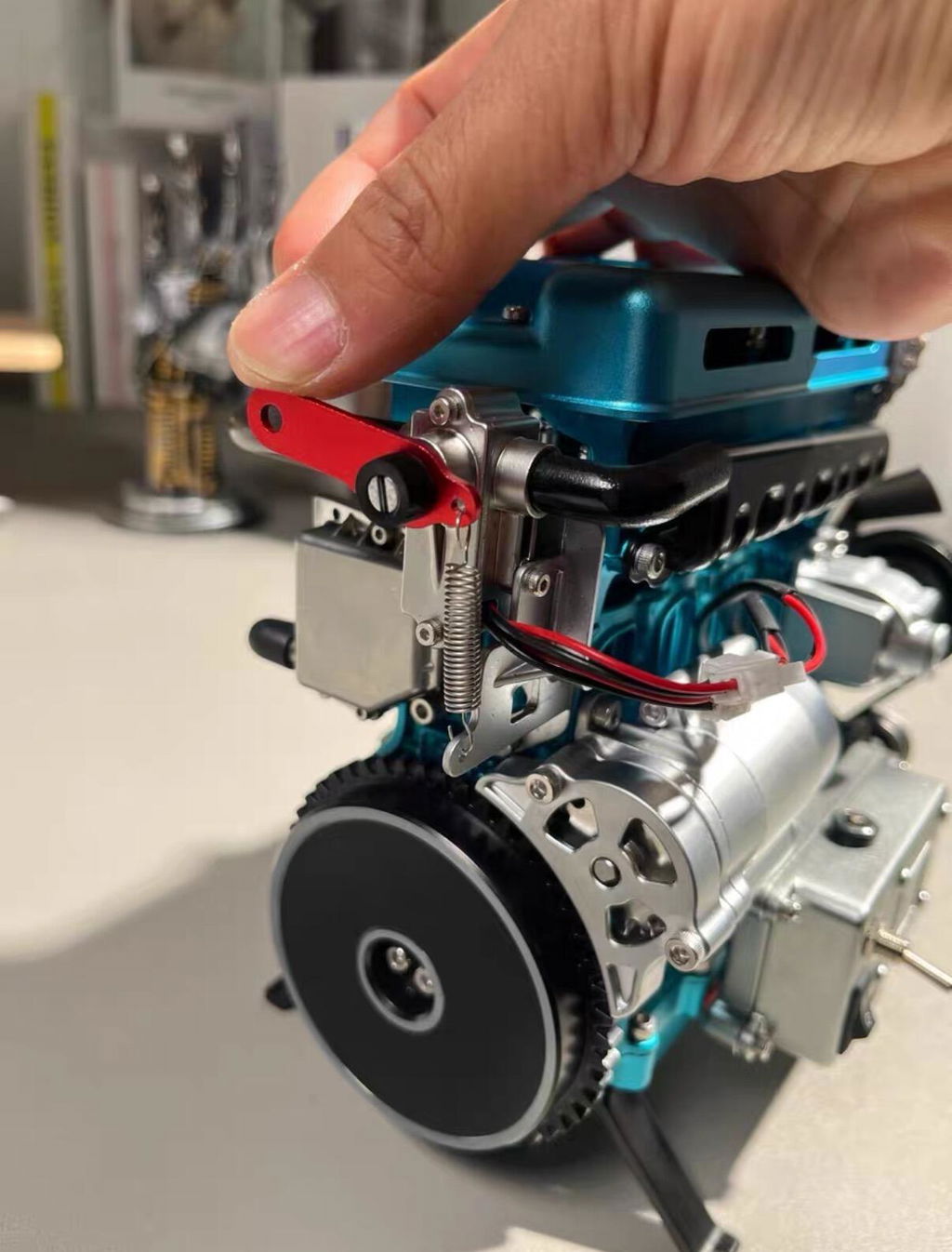
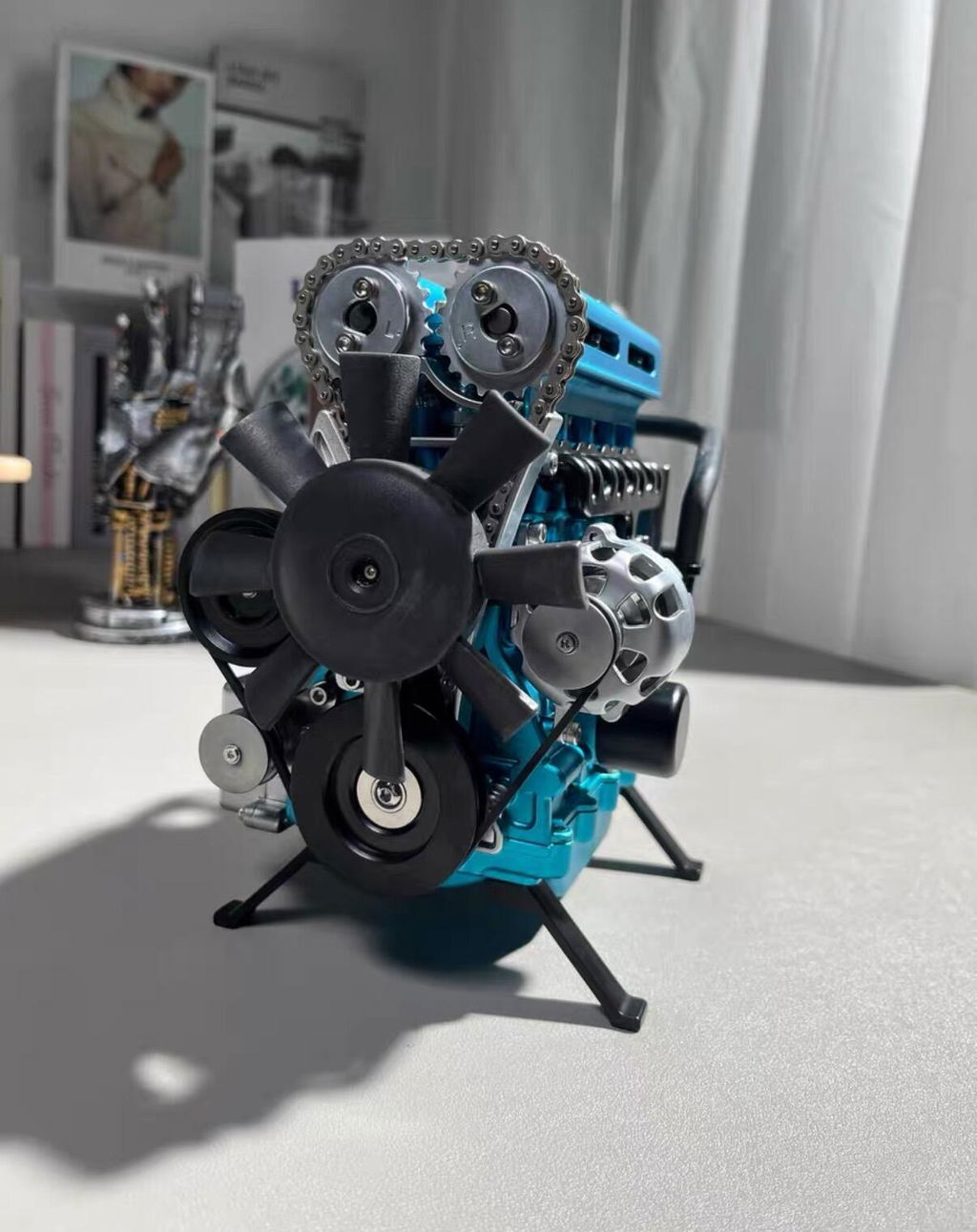
The ENGINEKITOR F2 7.5cc twin-cylinder engine makes this process especially interesting because it combines a real four-stroke combustion cycle with two cylinders, an SOHC valve train, CDI electronic ignition, electric starting and circulating water cooling.
In this guide, we will use the F2 as a real-world example to explain how a miniature gasoline engine works, what happens from the moment you press the starter, and why timing, ignition, cooling and fuel delivery all have to work together before a small engine can successfully run.

How Does a Miniature Gasoline Engine Work? The Short Answer
A miniature gasoline engine converts the chemical energy stored in fuel into mechanical rotation through internal combustion.
In a four-stroke engine, the basic sequence is:
Intake → Compression → Ignition & Power → Exhaust
The piston moves up and down inside the cylinder. A connecting rod transfers that movement to the crankshaft, and the crankshaft converts the piston's reciprocating motion into rotation.
Meanwhile, the camshaft controls the valves, the ignition system creates the spark, the fuel system supplies the combustible mixture, and the cooling system removes excess heat.
A working miniature engine therefore depends on several separate systems operating at the correct time—not simply on a piston moving inside a cylinder.
Is a Miniature Gasoline Engine a Real Engine?
Yes—when it uses actual fuel, compression, ignition and combustion, it is a genuine internal combustion engine operating on a miniature scale.
This is different from many motorized engine models.
In an electrically driven display model, an electric motor turns the crankshaft. The pistons and valves move because the electric motor is powering them. That can be extremely useful for demonstrating engine motion, but no combustion is producing the mechanical power.
In a working miniature gasoline engine such as the F2, the electric starter only helps crank the engine during startup.
Once the engine successfully fires, combustion inside the cylinders produces the force that keeps the crankshaft rotating.
| System | Motorized Display Engine | Miniature Gasoline Engine |
|---|---|---|
| Primary Running Power | Electric Motor | Internal Combustion |
| Fuel Required | No | Yes |
| Compression | Usually Simulated | Functional |
| Spark Ignition | Not Required | Required |
| Combustion Heat | No | Yes |
| Cooling System | Usually Unnecessary | Can Be Functional |
| Engine Tuning | Usually Not Required | Part of Operation |
What Happens When You Start a Miniature Gasoline Engine?
Understanding the startup sequence is one of the easiest ways to understand how the entire engine works.
In simplified form, the process looks like this:
- The starter turns the crankshaft.
- The crankshaft moves the pistons.
- The camshaft opens and closes the valves at the correct time.
- The engine draws in the fuel-and-air mixture.
- The piston compresses that mixture.
- The ignition system creates a spark.
- The mixture burns inside the combustion chamber.
- Expanding gas forces the piston downward.
- The connecting rod transfers the force to the crankshaft.
- The crankshaft continues rotating and the cycle repeats.
Once combustion produces enough repeating power strokes, the engine no longer depends on the starter motor to continue rotating.
This is the critical transition between cranking an engine and running an engine.
How Does the Four-Stroke Cycle Work in a Miniature Engine?
The F2 miniature four-stroke engine uses the same four basic stages that define a conventional four-stroke gasoline engine.
Stroke 1: Intake
The piston travels downward while the intake valve opens.
This creates space inside the cylinder and allows the incoming fuel-and-air mixture to enter the combustion chamber.
The timing of the intake valve matters. Opening too early, too late or remaining open at the wrong point in the cycle changes how effectively the cylinder can fill.
Stroke 2: Compression
The intake valve closes and the piston moves upward.
The mixture is trapped inside the combustion chamber and compressed into a much smaller volume.
Compression is important because a gasoline engine needs the correct conditions inside the cylinder before ignition can produce an effective power stroke.
Stroke 3: Power
Near the appropriate point in the cycle, the ignition system produces a spark at the spark plug.
The compressed fuel-and-air mixture burns rapidly. Expanding combustion gases push the piston downward.
This is the stroke that actually produces useful mechanical force.
The connecting rod transfers that force to the crankshaft, helping maintain crankshaft rotation.
Stroke 4: Exhaust
After the power stroke, the exhaust valve opens.
The piston moves upward again and pushes the combustion gases out of the cylinder.
Once the exhaust stroke finishes, the cylinder is ready to begin another intake stroke.
One complete four-stroke cycle therefore requires two full rotations of the crankshaft.
How Does a Piston Turn the Crankshaft?
The piston does not rotate. It moves up and down inside the cylinder.
The crankshaft, however, needs to rotate.
The connecting rod is the mechanical link between these two types of movement.
When combustion pushes the piston downward, the connecting rod applies force to an offset section of the crankshaft. Because that connection is offset from the crankshaft's centerline, the downward piston force creates rotational movement.
The basic conversion can be summarized as:
Reciprocating Piston Motion → Connecting Rod → Rotary Crankshaft Motion
This simple mechanical conversion is one of the most fundamental principles inside a piston internal combustion engine.
What Changes When a Miniature Engine Has Two Cylinders?
A single-cylinder engine only has one piston, one combustion chamber and one sequence of valve events to manage.
A twin-cylinder miniature engine adds another piston and combustion chamber to the system.
The ENGINEKITOR F2 uses two approximately 3.75cc cylinders for a combined displacement of 7.5cc.
Both pistons transfer their movement into the same crankshaft system. The valves and ignition events also have to remain synchronized with the mechanical position of each cylinder.
This creates several useful things to observe:
- Piston synchronization
- Shared crankshaft rotation
- Multi-cylinder valve timing
- Ignition sequencing
- Combustion events across two cylinders
- Changes in engine sound and running behavior

What Does the Camshaft Do?
The crankshaft determines piston position, but the engine also needs a way to control when gases can enter and leave each cylinder.
That is the job of the valve train.
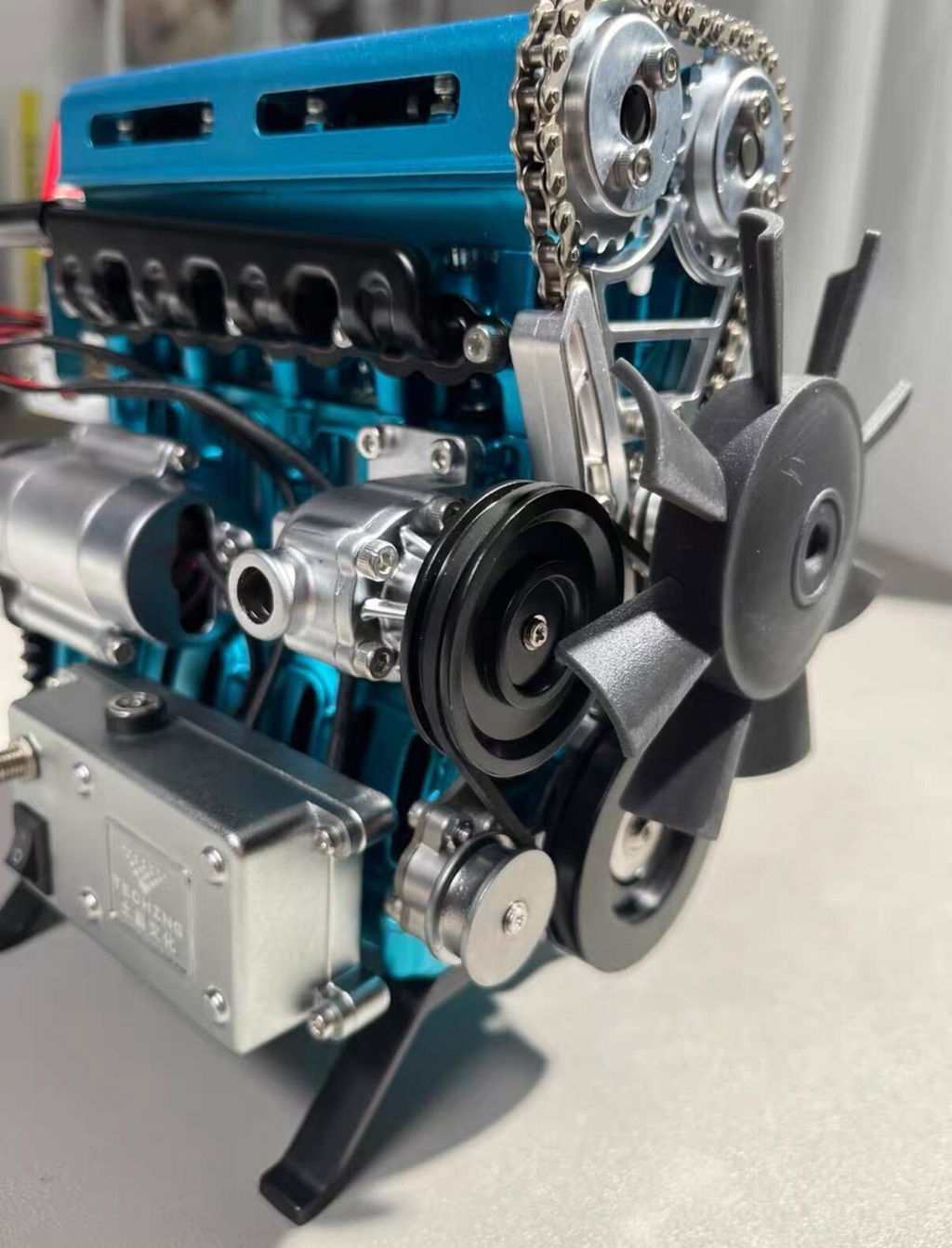
The F2 uses a Single Overhead Camshaft (SOHC) system.
The camshaft rotates in a fixed mechanical relationship with the crankshaft and controls the opening and closing of the intake and exhaust valves.
For a four-stroke engine to function correctly, valve movement must match piston position.
For example:
- The intake valve needs to open during the intake process.
- Both valves need to remain appropriately closed during compression.
- The combustion chamber needs to remain sealed during the power event.
- The exhaust valve needs to open when burned gases must leave the cylinder.
This synchronization between crankshaft and camshaft is what we commonly describe as engine timing.

How Does CDI Ignition Work in a Miniature Gasoline Engine?
Compression alone cannot make a gasoline engine run. The compressed mixture also has to ignite at the correct point in the engine cycle.
The F2 running system uses CDI electronic ignition, together with Hall sensing and spark plugs.
In simplified terms:
- The engine rotates.
- The sensing system determines the appropriate ignition position.
- The ignition system releases electrical energy.
- The spark plug creates a spark inside the combustion chamber.
- The compressed mixture ignites.
- The resulting combustion produces a power stroke.
Ignition timing therefore has to work together with piston position and valve timing.
A spark occurring at the wrong stage of the cycle cannot simply compensate for incorrect mechanical timing.
Why Does a Gasoline Engine Need an Electric Starter?
A stationary engine cannot produce its own first power stroke because its crankshaft is not yet rotating.
Something has to rotate the engine first.
The F2 uses an electric starter motor to turn the crankshaft during startup.
As the starter rotates the crankshaft:
- The pistons begin moving.
- The valves begin opening and closing.
- Fuel and air can enter the cylinders.
- Compression can occur.
- The ignition system can fire.
Once combustion becomes self-sustaining, the starter has completed its job.
This explains an important distinction:
The electric motor starts the engine—it does not continuously power the engine.
Why Does a Miniature Gasoline Engine Need Cooling?
Combustion releases heat as well as mechanical energy.
Even when an engine is very small, repeated combustion events can generate significant operating heat.
The ENGINEKITOR F2 water-cooled miniature engine uses circulating water cooling and an integrated mechanical water pump.
In a complete running setup, coolant travels through the cooling system, absorbs heat from the engine and moves toward the radiator, where heat can be transferred to the surrounding air.
The basic cooling loop can be viewed as:
Engine → Heated Coolant → Radiator → Cooler Coolant → Engine
The water pump keeps coolant circulating through this loop while the engine operates.

Why Can a Miniature Engine Fail to Run Even When Its Parts Move?
This is one of the most useful concepts to understand about a real internal combustion engine.
Seeing the crankshaft rotate does not automatically mean the conditions required for combustion are correct.
A functioning engine depends on several conditions occurring together:
- Correct mechanical assembly
- Correct crankshaft and camshaft synchronization
- Sufficient compression
- Appropriate fuel and air delivery
- Correct ignition behavior
- Functional spark plugs
- Appropriate operating setup
That is why working with a real miniature engine is a different experience from assembling a purely motorized mechanical model.
The builder is not only creating motion. The builder is creating the conditions required for controlled internal combustion.
The Four Systems That Must Work Together
An easy way to understand the F2—or almost any four-stroke miniature gasoline engine— is to divide it into four interconnected systems.
1. Mechanical System
Includes the pistons, connecting rods, crankshaft, camshaft, valves and timing components.
Its job is to create and control physical movement.
2. Fuel & Air System
Provides the combustible mixture required inside the cylinders.
Without the correct mixture entering the engine, compression and ignition alone cannot produce sustained combustion.
3. Ignition System
Provides the electrical spark needed to ignite the compressed mixture at the appropriate point in the engine cycle.
4. Cooling System
Helps manage the heat created during operation.
On the F2, this is accomplished through circulating coolant and a mechanical water pump.
A successful running engine is the result of all four systems working together.
The F2 as a Real Example of a Miniature Four-Stroke Engine
The ENGINEKITOR F2 provides a useful example because several systems that are often hidden inside a full-size engine can be studied on a much smaller platform.
| Feature | ENGINEKITOR F2 | What It Demonstrates |
|---|---|---|
| Engine Layout | Inline Twin-Cylinder | Multi-cylinder operation |
| Displacement | 7.5cc | Miniature combustion chambers |
| Cycle | Four-Stroke | Intake, compression, power and exhaust |
| Valve Train | SOHC | Camshaft and valve timing |
| Ignition | CDI | Spark-controlled combustion |
| Starting | Electric Motor | Engine cranking and startup |
| Cooling | Circulating Water Cooling | Thermal management |
| Water Pump | Mechanical | Coolant circulation |
| Operating Range | Approx. 1,600–12,000 RPM | Engine rotational speed |
For complete F2 dimensions, specifications, kit options and purchasing information, read our ENGINEKITOR F2 7.5cc Twin-Cylinder Engine Guide .
What Can You Learn From Building a Real Miniature Engine?
A working miniature internal combustion engine turns abstract engineering concepts into mechanical relationships that can be observed directly.
How Motion Is Converted
You can see how piston motion becomes crankshaft rotation.
Why Timing Matters
You can understand why valves and pistons have to remain mechanically synchronized.
How Combustion Produces Power
You can follow the sequence from fuel and air through compression, ignition, combustion and mechanical output.
Why Cooling Is Necessary
A real engine demonstrates that combustion generates heat that must be managed during operation.
Why an Engine Is a System
Perhaps the most important lesson is that an internal combustion engine is not simply a piston, crankshaft or spark plug.
It only runs when many mechanical and electrical systems operate together.
Common Questions About Miniature Gasoline Engines
Do miniature gasoline engines actually burn fuel?
A real miniature internal combustion engine does. Fuel combustion provides the energy that produces the engine's mechanical motion once it has successfully started.
Does a miniature gasoline engine work like a car engine?
The fundamental four-stroke principles can be very similar: intake, compression, ignition and power, followed by exhaust. However, construction, fuel systems, lubrication, cooling arrangements and operating procedures can vary between engine designs.
Why does the crankshaft need to rotate before the engine can start?
Initial rotation moves the pistons and valve train, allowing intake, compression and ignition events to begin. The F2 uses an electric starter motor for this initial cranking process.
What is the difference between starting and running?
Starting means externally rotating the engine until combustion begins. Running means repeated combustion events are producing enough mechanical energy for the engine to continue operating.
Why does a four-stroke engine need a camshaft?
The camshaft controls valve opening and closing so the intake and exhaust processes occur at the correct stages of the piston cycle.
Does a miniature gasoline engine need cooling?
Real combustion produces heat. Depending on engine design, thermal management may therefore be required. The ENGINEKITOR F2 uses circulating water cooling with a mechanical water pump.
What does CDI mean?
CDI refers to Capacitor Discharge Ignition. It is an electronic ignition method used to create the electrical energy needed for spark ignition.
Is the electric starter what powers the F2?
No. The electric starter rotates the engine during startup. Once the F2 is successfully running, internal combustion provides its operating mechanical power.
How fast does the F2 engine run?
The published operating range of the F2 is approximately 1,600–12,000 RPM. Actual running behavior depends on setup, tuning and operating conditions.
Where can I see the complete F2 specifications?
See our complete F2 7.5cc twin-cylinder engine guide or visit the ENGINEKITOR F2 product page .
Remember: A Miniature Gasoline Engine Is Still an Internal Combustion Engine
Small size does not remove the operating considerations associated with fuel, ignition, rotating components and combustion heat.
When operating the F2:
- Use it in a well-ventilated outdoor environment.
- Keep fuel away from flames and unintended ignition sources.
- Secure the engine and base before startup.
- Keep hands, clothing and loose objects away from moving parts.
- Wear appropriate eye protection.
- Do not touch hot components immediately after operation.
- Follow the supplied assembly and operating instructions.
- Use only operating procedures appropriate for the F2.
So, How Does a Miniature Gasoline Engine Really Work?
At its core, the answer is simple:
A miniature gasoline engine uses controlled combustion to push pistons, and the crankshaft converts that piston movement into rotary mechanical power.
But making that process happen repeatedly requires much more.
Fuel and air have to enter at the right time. The piston has to create compression. The valves have to remain synchronized with the crankshaft. The ignition system has to produce a spark at the appropriate point. Combustion has to generate a useful power stroke. Heat has to be managed.
The ENGINEKITOR F2 7.5cc twin-cylinder gasoline engine brings those systems together in a compact working platform that builders can assemble, observe and operate.
That is what makes a real miniature engine so different from a display model: the movement you see is the result of an actual mechanical and combustion process.
Explore the ENGINEKITOR F2
Ready to see the complete engine, available kit configurations and current product details?
View the F2 7.5cc Twin-Cylinder Engine →
Or read our complete F2 specifications and buyer's guide .
```


Dejar un comentario